
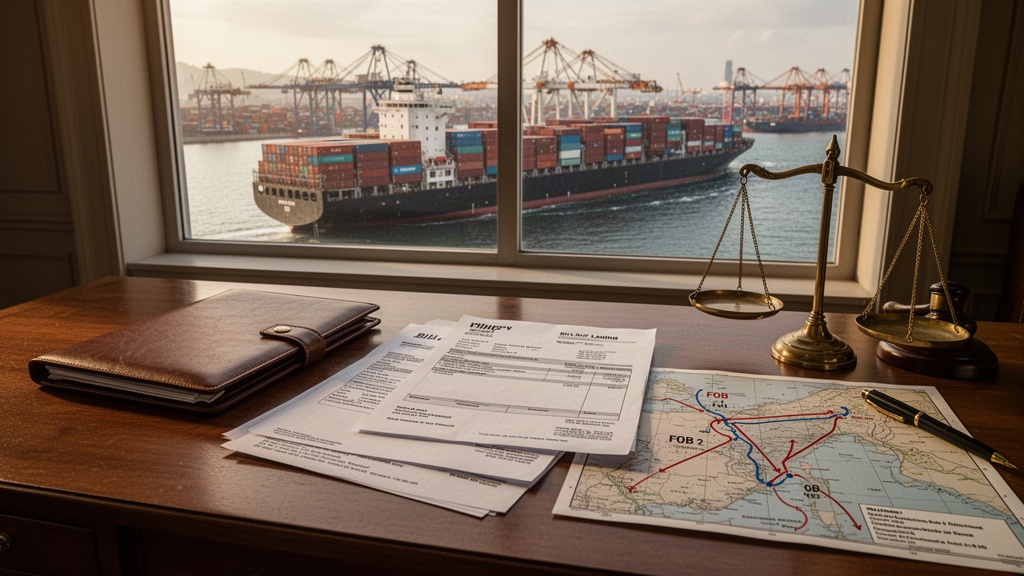
FOB incoterm — three letters that shape millions of international trade contracts every year. Free On Board is one of the eleven rules published in Incoterms® 2020 by the International Chamber of Commerce (ICC), and it remains one of the most widely used — and most frequently misunderstood — terms in global commerce. When a seller and buyer agree to ship goods under FOB, they are dividing costs, logistics responsibilities, and legal risk at a very specific moment: the point at which goods are placed on board a named vessel at the agreed port of shipment. Getting that division wrong can mean unexpected costs, uninsured losses, or contractual disputes that drag on for months. Understanding exactly what FOB commits each party to is not optional — it is the foundation of a sound export or import strategy.
What the FOB Incoterm Means in International Trade
FOB stands for "Free On Board" and is defined under Incoterms® 2020 as a rule that applies exclusively to sea freight and inland waterway transport. That restriction is not a technicality — it is a hard boundary. FOB cannot be validly used for air, road, rail, or multimodal shipments where goods are handed to a carrier before they reach the vessel. In those scenarios, the FCA (Free Carrier) rule is the appropriate alternative.
Under FOB, the seller's delivery obligation is fulfilled at the moment the goods are placed on board the vessel nominated by the buyer at the named port of shipment. That port must be specified in the contract. A clause reading simply "FOB, Incoterms® 2020" is incomplete; the correct form is "FOB [named port], Incoterms® 2020."
The ICC's Incoterms® 2020 publication is the authoritative source for interpreting FOB. It sets out, article by article, the obligations of each party: who arranges transport, who handles export clearance, who bears costs up to and after the delivery point, and when risk passes. Contracts that reference an older version — such as Incoterms® 2010 — operate under slightly different rules, so version clarity in the contract is not a minor drafting point.
One common source of confusion involves the American commercial expressions "FOB shipping point" and "FOB destination," used in U.S. accounting and domestic sales law. These terms do not automatically correspond to the ICC's FOB rule. A contract using "FOB shipping point" without explicitly referencing Incoterms® 2020 may be interpreted under U.S. domestic law rather than international trade rules — a distinction with real legal consequences, particularly for disputes involving U.S. Customs and Border Protection (CBP) or the U.S. Census Bureau's export reporting requirements.
Who Pays for What Under FOB?
Cost allocation under FOB follows the delivery point: everything up to and including loading on board the vessel is the seller's financial responsibility, and everything after falls to the buyer. In practice, that split covers a wide range of line items that traders sometimes overlook when negotiating price.
The seller typically covers pre-carriage (inland transport from the factory or warehouse to the port of shipment), terminal handling charges at the export port, and the cost of export customs clearance — including export licenses, duties if applicable, and the preparation of export documentation. In the United States, exporters must also file Electronic Export Information (EEI) through the Automated Export System, a requirement administered by the U.S. Census Bureau. That compliance cost sits with the seller under FOB.
Once the goods are on board, the buyer takes over. The buyer arranges and pays for the main ocean freight, marine cargo insurance if desired (FOB does not require the seller to insure the goods), import customs clearance in the destination country, import duties and taxes, and final delivery to the destination. For shipments entering the United States, the importer of record bears responsibility before CBP for accurate tariff classification, payment of duties, and compliance with any trade sanctions or import restrictions.
Port charges deserve particular attention. Terminal handling fees, congestion surcharges, and documentation fees vary significantly by port and by the terms of the buyer's freight contract. Parties should confirm with their freight forwarder which charges fall before and after the on-board moment, since some terminal operators apply fees that do not fit neatly into the standard FOB cost split. Leaving these items undefined in the contract is a reliable path to post-shipment disputes.
When Does Risk Transfer from Seller to Buyer?
The risk transfer point under FOB is precise: risk passes from seller to buyer when the goods are placed on board the named vessel at the agreed port of shipment. Before that moment, any loss or damage to the goods — a warehouse fire, a forklift accident at the terminal, goods falling during loading — is the seller's problem. After that moment, it is the buyer's.
This on-board trigger matters enormously for cargo insurance. FOB does not require the seller to take out insurance for the buyer's benefit. Once goods cross the ship's rail and are on board, the buyer bears the economic risk of loss during the ocean voyage, yet the buyer may not have arranged cover. Experienced importers purchase marine cargo insurance before the vessel departs; those who do not are self-insuring a risk that can be substantial, particularly for high-value or fragile goods.
Risk transfer and transfer of ownership (title) are separate legal concepts. FOB governs when economic risk moves between parties, not when legal title to the goods passes. Title transfer is determined by the applicable law of the contract — often the law of the seller's or buyer's country, or the United Nations Convention on Contracts for the International Sale of Goods (CISG) if both parties are in contracting states. A well-drafted sales contract addresses both risk and title explicitly, rather than assuming FOB resolves the question of ownership.
A practical implication: if goods are damaged after loading but before the buyer can inspect them at destination, the buyer must pursue a claim against the carrier or insurer, not the seller. That claim requires proper documentation — a clean bill of lading, timely notice of damage, and survey reports. Buyers who are unfamiliar with cargo claims procedures often discover, too late, that their rights depend on steps taken within days of delivery.
FOB Compared with FCA, CFR, and CIF
Choosing the right Incoterm requires understanding how FOB stacks up against the alternatives most frequently used in sea freight. The table below summarizes the four rules most relevant to ocean shipments.
| Rule | Permitted Transport Modes | Delivery Point | Who Arranges Main Freight | Risk Transfer Moment | Insurance Obligation | Recommended Use |
|---|---|---|---|---|---|---|
| FOB | Sea / inland waterway only | On board vessel at named export port | Buyer | When goods are on board at export port | None (buyer's choice) | Bulk cargo, commodities, when buyer controls freight |
| FCA | All modes, including multimodal | Named place (carrier's premises or other) | Buyer | When goods are handed to carrier at named place | None (buyer's choice) | Containerized cargo, air freight, any mode |
| CFR | Sea / inland waterway only | On board vessel at export port | Seller | When goods are on board at export port | None (buyer's choice) | When seller arranges freight but buyer handles insurance |
| CIF | Sea / inland waterway only | On board vessel at export port | Seller | When goods are on board at export port | Seller must insure (minimum cover) | When buyer wants seller to arrange freight and basic insurance |
The FCA rule deserves particular attention for containerized shipments. When goods are loaded into a container at an inland container depot and then trucked to the port, the on-board moment under FOB may not reflect the actual point where the seller loses control of the goods. FCA at the named container terminal aligns the risk transfer more accurately with the commercial reality of container logistics, which is why the ICC explicitly recommends FCA over FOB for containerized cargo in the Incoterms® 2020 guidance notes.
Contract Checks and Common Legal Mistakes
The most frequent FOB error is using the term without naming a specific port. "FOB, Incoterms® 2020" is incomplete and potentially unenforceable as written. The contract must read "FOB [port name], Incoterms® 2020" to create a clear, legally operative delivery point. Without a named port, neither party can determine when risk passes or who owes what costs.
A second persistent mistake involves applying FOB to containerized shipments. Sellers who agree to FOB for container cargo often find themselves responsible for terminal handling charges and inland haulage costs that they did not anticipate, because the goods are in the carrier's custody long before they reach the vessel. Freight forwarders and trade lawyers regularly see contracts where FOB was chosen by habit rather than by analysis of the actual logistics chain.
U.S. importers and exporters face an additional layer of complexity. The International Trade Administration (ITA) and CBP both publish guidance on how Incoterms interact with U.S. customs valuation rules. The customs value of imported goods is generally based on the transaction value, and whether freight and insurance are included or excluded from that value depends partly on the Incoterm used. Using FOB affects how the dutiable value is calculated for goods entering the United States — a point that matters when tariff rates are significant.
Sellers should also verify that their export compliance obligations are fully met before the goods leave their country. Under FOB, the seller handles export clearance, which includes obtaining any required export licenses, complying with trade sanctions screening, and filing the EEI where required by the U.S. Census Bureau. Failures at this stage can result in penalties that have nothing to do with the buyer's conduct.
Finally, FOB does not address payment terms, governing law, or dispute resolution. A contract that specifies "FOB Shanghai, Incoterms® 2020" has defined delivery and risk transfer — and nothing else about the legal framework of the transaction. Governing law clauses, dispute resolution mechanisms (arbitration or litigation), and force majeure provisions must be drafted separately. Relying on FOB alone to structure a cross-border sale leaves significant legal ground uncovered, regardless of how well the logistics are planned.