
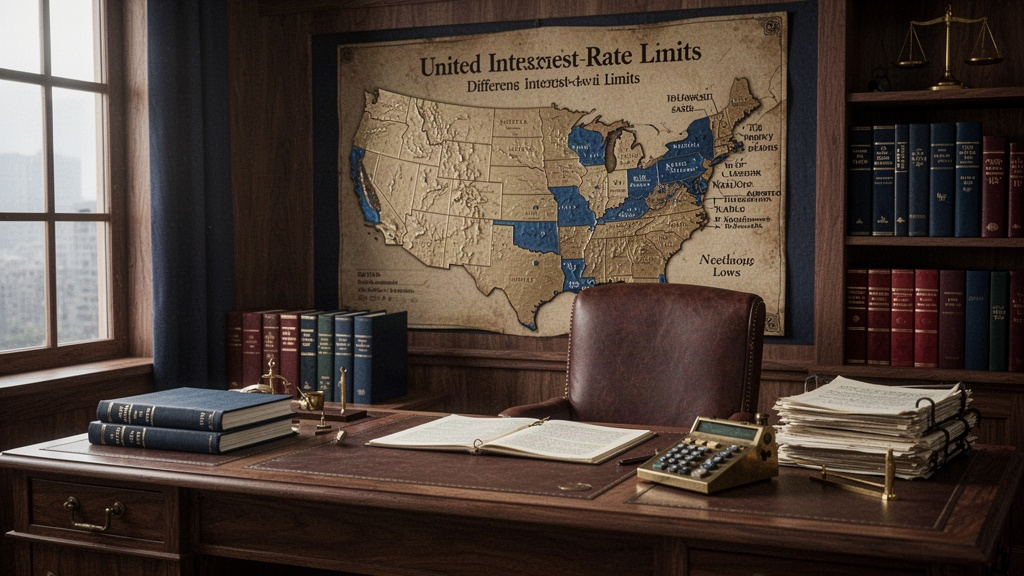
Usury laws determine how much interest a lender can legally charge on a loan. In the United States, these rules are not set by a single federal authority — they emerge from a patchwork of state statutes, federal banking regulations, and court decisions that have accumulated over decades. The result is a system where the maximum allowable rate on a personal loan can differ dramatically depending on where you live, who is lending, and what type of credit is involved. Borrowers in one state may face legal protection at 10% annual interest, while those in a neighboring state may have no effective cap at all on certain products. Understanding how these limits apply — and when federal rules override them — requires navigating both state and federal law with precision.
How Usury Laws Work in the United States
Usury, in its legal sense, refers to the practice of charging interest or credit costs above the maximum rate permitted by applicable law. That ceiling is called a usury cap, and its scope depends on the jurisdiction, the type of loan, the lender's charter, and the borrower's status. No single federal statute sets a universal maximum interest rate for all consumer loans in the country.
Three distinct metrics measure credit costs, and confusing them leads to errors. The Annual Percentage Rate (APR) reflects interest plus certain fees under federal Truth in Lending Act disclosure rules. The nominal interest rate is narrower, covering only interest. The Military Annual Percentage Rate (MAPR), used under the Military Lending Act, captures a broader set of costs including credit insurance premiums and application fees. A lender can comply with one measure while violating another.
State usury rules generally fall into two categories. Some states set a fixed statutory ceiling — say, 10% or 18% per year — that applies to all loans unless a specific exemption applies. Others use a formula tied to an external benchmark, such as the federal discount rate plus a set number of percentage points. Many states layer multiple caps depending on loan size, purpose, or borrower type, which means the same lender may face different ceilings for a $500 payday advance versus a $50,000 personal loan.
When a contract is silent on interest rate, a default interest rate applies. Under 12 U.S.C. § 85, national banks may charge the rate allowed in the state where the bank is located, and where no contract rate exists, a federal default of 7% per year has historically applied to certain obligations. This is not a general consumer protection ceiling — it is a gap-filler for contracts that failed to specify a rate.
State-by-State Interest Rate Limits
State caps vary so widely that national comparisons require careful qualification. The table below provides a representative overview of selected states. These figures reflect the general legal framework as of the date of this publication, but each state's rules must be verified against current official statutes, because exemptions, lender-specific rules, and legislative amendments change frequently.
| State | General Consumer Cap (approx.) | Commercial Loans | Cap Type | Key Exemptions | Possible Sanctions | Official Source |
|---|---|---|---|---|---|---|
| New York | 16% (civil), 25% (criminal) | No general cap for business loans over certain thresholds | Fixed statutory ceiling | Licensed lenders, banks, certain business loans | Loan void, forfeiture of interest | N.Y. Gen. Oblig. Law § 5-501 |
| California | 10% for non-exempt lenders | Largely exempt for licensed finance lenders | Fixed statutory ceiling | Licensed lenders under CFL, banks | Restitution of excess interest | Cal. Const. Art. XV; Cal. Fin. Code |
| Texas | 6% default; up to 18% by contract | Parties may agree to higher rates for business loans | Contract-based with ceiling | Regulated lenders, certain commercial agreements | Forfeiture of all interest | Tex. Fin. Code § 302.001 et seq. |
| Delaware | No general cap for most loans | No general cap | No ceiling (deregulated) | N/A — broadly deregulated | Varies by product type | Del. Code tit. 6, § 2301 |
| Illinois | 9% default; varies by product | Generally uncapped for business loans above threshold | Default rate plus product rules | Banks, licensed lenders, payday loan statutes | Excess interest recoverable | 815 ILCS 205/ |
| Florida | 18% (under $500K); 25% (over $500K) | Higher ceiling for larger commercial transactions | Tiered fixed ceiling | Banks, certain regulated products | Criminal usury, loan voidable | Fla. Stat. § 687.01 et seq. |
Several states, including Delaware and South Dakota, have deliberately removed or minimized interest rate ceilings to attract bank charters and credit card issuers. This is not an accident — it reflects a deliberate policy choice made decades ago that reshaped the national credit card market.
When Federal Banking Rules Override State Caps
A national bank chartered by the Office of the Comptroller of the Currency (OCC) is not always bound by the usury cap of the state where its borrower lives. Under 12 U.S.C. § 85, a national bank may charge the interest rate permitted in the state where the bank itself is located — and export that rate to borrowers in other states. The Supreme Court confirmed this principle in Marquette National Bank v. First of Omaha Service Corp. (1978), a decision that directly enabled banks to locate in low-cap states and lend nationally at higher rates.
State-chartered banks insured by the FDIC receive comparable treatment under 12 U.S.C. § 1831d. Federal credit unions operate under a separate ceiling set by the National Credit Union Administration, currently capped at 18% APR absent a temporary exception. The Federal Reserve Board and the OCC have both issued guidance clarifying that preemption applies to the rate itself, not merely to the act of charging interest.
The more contested question involves non-bank lenders and fintech platforms. Courts have debated whether a loan originated by a bank but immediately assigned to a non-bank partner retains its preemption protection. The OCC's "valid-when-made" rule, finalized in 2020, attempted to preserve interest rate validity after loan assignment — but several states challenged this position in court, and the legal landscape for marketplace lending partnerships remains unsettled as of 2026.
A choice-of-law clause in a loan contract can designate which state's law governs the agreement, but courts do not automatically enforce such clauses. If the chosen state has no substantial relationship to the transaction, or if applying that law would violate the public policy of the borrower's home state, a court may disregard the clause and apply local usury limits instead.
Military Lending Act and Other Federal Protections
The Military Lending Act (MLA), codified at 10 U.S.C. § 987 and implemented through 32 CFR Part 232, provides a specific federal ceiling for covered borrowers: a 36% Military Annual Percentage Rate (MAPR). This applies to active-duty servicemembers and their covered dependents on a defined set of consumer credit products. The MAPR calculation includes interest, application fees, credit insurance premiums, and other charges that would not necessarily appear in a standard APR disclosure.
The MLA prohibition is not a general consumer protection cap. It does not apply to mortgages, purchase-money auto loans, or loans secured by personal property used to purchase that property. It does cover payday loans, deposit advance products, overdraft lines of credit, and installment loans that meet the statutory definition. Lenders who violate the MLA face significant consequences: the loan contract is void from inception, and the lender may not collect any interest, fees, or principal on the covered transaction.
Beyond the MLA, the Consumer Financial Protection Bureau (CFPB) enforces the Truth in Lending Act and its implementing regulation, Regulation Z, which mandates standardized APR disclosure across consumer credit products. The Federal Trade Commission (FTC) retains authority over non-bank lenders under Section 5 of the FTC Act, prohibiting unfair or deceptive practices — including misleading representations about the true cost of credit.
State attorneys general can enforce both state usury statutes and, in some circumstances, federal consumer protection laws. Their investigative and litigation powers vary, but several state-level enforcement actions against high-rate lenders have resulted in settlements requiring restitution to borrowers and permanent injunctions against certain lending practices.
Penalties, Time Limits, and Legal Remedies
The consequences of charging an illegal interest rate range from modest to severe depending on the jurisdiction. Some states treat usury as a civil matter only, requiring the lender to refund excess interest paid. Others impose criminal penalties — New York, for instance, makes charging over 25% APR a criminal offense under its Penal Law. Florida distinguishes between civil usury and criminal usury, with the criminal threshold set at 25% and additional felony exposure at 45%.
At the most punitive end, certain states void the entire loan contract when a usury violation is found. The lender loses not only the right to collect interest but also the right to recover the principal. Texas law, for example, allows a borrower to recoup twice the amount of usurious interest paid, and in cases of intentional violation, the lender forfeits all interest charged. These rules create strong incentives for lenders to verify applicable caps before extending credit.
Statutes of limitations for usury claims are not uniform. The clock may start running from the date of the loan, from the date of each payment, or from the date the borrower discovered the violation — and each state applies its own rule. Some claims sound in contract, others in tort or under consumer protection statutes, and each characterization can trigger a different limitations period. A borrower who waited three years to bring a claim might be timely in one state and time-barred in another.
Remedies can be pursued in state courts, federal courts, or before administrative agencies such as the CFPB or state banking regulators. Class actions have been used effectively against high-rate lenders, particularly in states where individual damages are too small to justify solo litigation. Any borrower who suspects a rate violation should consult a licensed attorney in the relevant jurisdiction, because procedural rules, available defenses, and the strength of available evidence all affect whether a claim is worth pursuing.
Lenders operating across multiple states must conduct a jurisdiction-by-jurisdiction compliance review before launching any credit product. The applicable cap, the lender's charter type, the loan amount, the borrower's location, and any choice-of-law clause each feed into the analysis. Getting any one of those variables wrong can expose a lender to regulatory action, private litigation, or criminal referral — consequences that no rate of return can offset.