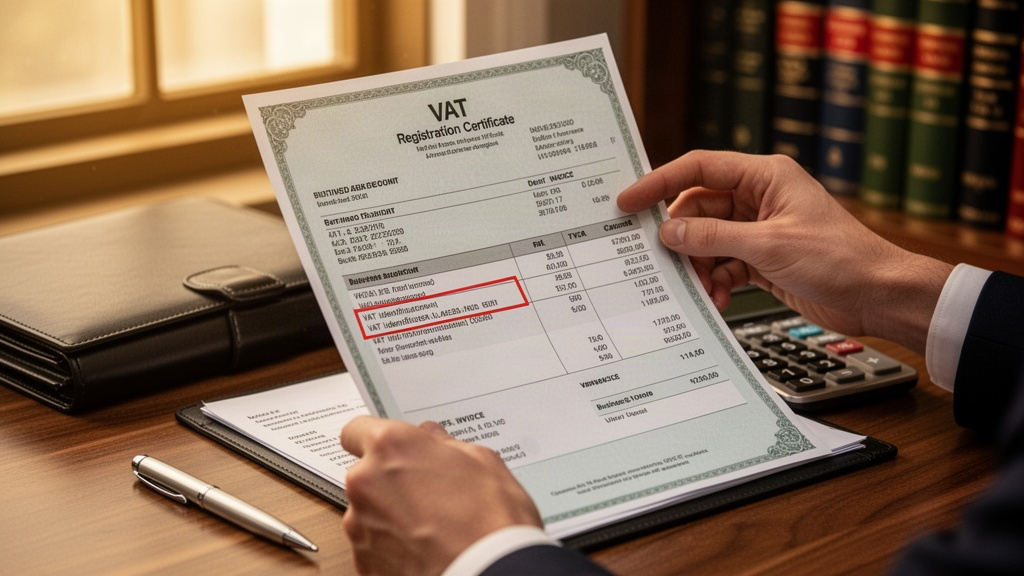

A VAT tax ID sits at the heart of how businesses account for value-added tax across dozens of jurisdictions. Without one, a company cannot legally charge VAT, reclaim input tax or issue compliant invoices in countries where VAT registration is mandatory. Whether you run a UK-based retailer, an EU e-commerce store or a non-established business selling digital services to European consumers, understanding what a VAT identification number is and whether you need one can determine your legal standing and your cash flow. The rules are territorial, not universal, and they shift regularly. This guide covers the core concepts, the main registration triggers and the compliance obligations that follow registration, drawing on official frameworks including the EU VAT Directive 2006/112/EC and HMRC guidance.
Understanding the VAT Tax ID: Definition and Format
A VAT tax ID, also called a VAT number or VAT registration number, is a unique identifier issued by a national tax authority to a business that has registered for value-added tax. Its primary purpose is to link taxable transactions to a specific legal entity, enabling tax authorities to track output VAT charged on sales and input VAT claimed on purchases. Without this number, a business cannot legally operate within the VAT system of the country that issued it.
The format varies considerably by country. EU VAT numbers follow a pattern of an ISO country prefix followed by a national identifier: a German number starts with DE, a French one with FR, an Italian one with IT. The total length ranges from eight to fourteen characters depending on the member state. UK VAT numbers issued by HMRC consist of nine digits, sometimes preceded by the prefix GB for international use. These structural differences matter when validating a supplier's number before processing an invoice.
A VAT tax ID is not interchangeable with other business identifiers. In the United States, an Employer Identification Number (EIN) issued by the IRS identifies a business for federal tax purposes but carries no VAT function, since the US operates no federal VAT system. A UK Companies House registration number is a corporate identifier, not a tax ID. A state sales-tax permit in a US state addresses a different levy entirely. Treating these as equivalents leads to compliance errors on cross-border invoices.
Business customers have a direct interest in verifying supplier VAT numbers. In the EU, the VIES system (VAT Information Exchange System), operated by the European Commission, allows any user to check whether a VAT number is recognised for intra-EU transactions. A valid VIES result supports zero-rating on qualifying cross-border supplies. A failed validation does not automatically prove fraud, but it does require the buyer to investigate further before applying any preferential VAT treatment.
Who Must Register: Triggers and Thresholds
The most straightforward trigger for VAT registration is exceeding a national taxable turnover threshold. In the United Kingdom, that threshold stood at approximately £90,000 from 1 April 2024; the figure applicable in 2026 should be confirmed against current HMRC guidance before relying on it. Once a business's taxable turnover crosses the threshold within any rolling twelve-month period, registration becomes mandatory, not optional.
Taxable turnover is not simply total revenue. It covers supplies that are standard-rated, reduced-rated or zero-rated under the applicable rules. Exempt supplies, such as many financial services or certain residential property transactions, do not count toward the threshold. Getting this calculation wrong can mean late registration, back-dated VAT liabilities and penalties.
Voluntary registration below the threshold is available in many jurisdictions and makes commercial sense when a business incurs significant input VAT on purchases. A startup buying equipment and professional services before its first sale may recover that VAT earlier by registering voluntarily, improving cash flow during the growth phase.
Cross-border activity creates registration obligations that operate independently of domestic turnover. A non-established business selling goods or digital services to consumers in EU member states may face registration requirements in those states from the first euro of supply, unless it qualifies for the One Stop Shop (OSS) scheme, which consolidates reporting into a single EU declaration. Import VAT, marketplace rules and distance-selling thresholds add further layers. A non-UK business selling goods to UK customers may need to register with HMRC regardless of its domestic turnover. The reverse charge mechanism shifts the VAT accounting obligation to the customer in many B2B cross-border scenarios, but it does not eliminate the need to understand which party holds the registration obligation.
How the UK, EU and US Systems Compare
| Feature | United Kingdom | EU Member States | United States |
|---|---|---|---|
| Indirect tax system | VAT | VAT (harmonised under EU Directive) | State sales tax (no federal VAT) |
| VAT tax ID issued | Yes — GB prefix | Yes — country-specific prefix | No federal VAT ID |
| Competent authority | HMRC | National tax authority of each member state | IRS (federal); state revenue departments |
| Primary registration trigger | Taxable turnover exceeds national threshold | Taxable turnover or cross-border supply rules | Economic nexus by state (sales tax) |
| Number validation tool | HMRC VAT checker | VIES (European Commission) | No equivalent federal tool |
| Key risk area | Post-Brexit cross-border obligations | Multi-state registration vs OSS eligibility | State-by-state nexus and permit requirements |
The table illustrates why a single global compliance strategy cannot exist. A business operating across all three markets needs separate registrations and separate compliance processes in each territory. The EU VAT Directive 2006/112/EC provides a common legal framework for all twenty-seven member states, but each state implements its own rates, filing frequencies and administrative procedures. The UK's framework, rooted in the Value Added Tax Act 1994, diverged further from EU rules after Brexit, particularly for goods crossing the GB-EU border.
Post-Registration Obligations Every Business Must Meet
Receiving a VAT tax ID is the starting point, not the finishing line. From the effective date of registration, a business must charge the correct VAT rate on every taxable supply. EU rules set a floor of 15% for standard rates across member states, though actual standard rates vary between countries. Reduced, zero and exempt treatments apply to specific categories of goods and services defined by national law within EU parameters.
Every VAT-registered business must issue compliant VAT invoices for B2B supplies. A valid invoice includes the supplier's VAT number, the customer's VAT number where the reverse charge applies, the date of supply, a description of the goods or services, the net amount, the VAT rate applied and the VAT amount. Missing fields invalidate the document and can prevent the customer from recovering input tax.
VAT returns must be filed at the frequency set by the relevant tax authority, typically quarterly or monthly, with payment of any net VAT due. The return reconciles output VAT collected from customers against input VAT paid on eligible business purchases. Where input VAT exceeds output VAT, the business may claim a repayment. Record-keeping obligations run for a minimum period set by national law, often six years in the UK, and digital record-keeping requirements are expanding under initiatives such as Making Tax Digital.
Businesses must display their VAT number on invoices, websites and certain business stationery. For cross-border transactions, validating the customer's VAT number through VIES or the relevant national tool before applying zero-rating is a legal requirement, not an administrative preference.
Penalties, Changing Rules and When to Seek Professional Advice
Failure to register on time carries financial consequences. HMRC can assess VAT from the date registration should have occurred, meaning a business faces a historic liability plus interest and potential penalties, even on sales where no VAT was collected from customers. EU tax authorities operate similar assessment and penalty regimes, though the specific rates, limitation periods and appeal procedures differ by member state.
Thresholds and rates change. The UK threshold moved to £90,000 in 2024; any further adjustment in 2026 will be announced through the annual Autumn Budget or a statutory instrument. EU member states adjust reduced rates and exemptions through domestic legislative processes. Businesses relying on figures that were accurate last year risk miscalculating their registration date or their VAT liability.
Digital reporting is expanding. The UK's Making Tax Digital for VAT programme already requires compatible software for most registered businesses. Several EU member states are rolling out real-time or near-real-time e-invoicing and digital reporting obligations that will affect businesses registered in those territories. Non-compliance with digital requirements attracts its own penalty regime, separate from late registration or underpayment penalties.
Administrative appeals against VAT assessments follow national procedures. In the UK, the route runs through HMRC's review process and then the First-tier Tribunal (Tax). EU member states each have their own administrative and judicial appeal channels. Limitation periods for assessments and repayment claims are set by national statute and cannot be generalised across jurisdictions. A qualified VAT adviser or tax lawyer familiar with the specific national rules is the only reliable source of personalised compliance advice for any business navigating registration, cross-border obligations or a dispute with a tax authority.