VAT code is a term that appears constantly in business correspondence, accounting software, and tax filings — yet its meaning shifts depending on the context. For a UK business owner, it might refer to a VAT registration number issued by HMRC. For an accountant using bookkeeping software, it could mean an internal tax rate code applied to transactions. Understanding what is VAT code in each context is not optional: getting it wrong on an invoice or a tax return carries real legal and financial consequences. This guide covers the different meanings of the term, where to locate your VAT number, how to verify a supplier's registration, and how to apply VAT details correctly across invoices and cross-border transactions. Rules differ between the UK, the EU, and other English-speaking jurisdictions, so precision matters throughout.
What Is a VAT Code? Understanding the Different Meanings
The phrase VAT code does not have a single legal definition. Depending on who uses it and where, it refers to at least two distinct concepts that should not be conflated. Confusing them leads to errors on invoices, incorrect tax filings, and potential penalties from tax authorities.
The first meaning is a VAT identification number, sometimes called a VAT registration number or VAT ID. This is a unique reference assigned by a national tax authority to a business that has registered for VAT. In the UK, HM Revenue & Customs (HMRC) issues these numbers in the format GB followed by nine digits — for example, GB123456789. In EU member states, the format varies by country but always starts with a two-letter country prefix under the VAT Directive 2006/112/EC. This number identifies your business on invoices, VAT returns, and cross-border transactions.
The second meaning is a tax rate code used inside accounting or invoicing software. Platforms such as Xero, QuickBooks, or Sage assign short codes — like "S" for standard rate, "Z" for zero-rated, or "E" for exempt — to tell the system how to treat a given transaction. These codes are internal. They do not appear on a legal invoice sent to a customer, and they have no official status with any tax authority.
A third, less common usage appears in some jurisdictions where commodity codes or customs tariff headings influence VAT treatment on imported goods. This is a separate concept entirely, relevant primarily to import declarations rather than standard invoicing.
When someone asks for your "VAT code," clarify which meaning applies before responding. A supplier asking for it on a purchase order almost certainly wants your VAT registration number. A finance team configuring a new accounting system is asking about internal tax codes. The legal obligations attached to each are entirely different.
Where to Find Your VAT Registration Number
Once a business registers for VAT, the registration number appears in several places. Knowing where to look saves time and avoids the mistake of quoting an incorrect or outdated reference on official documents.
Your VAT number can be found in the following locations:
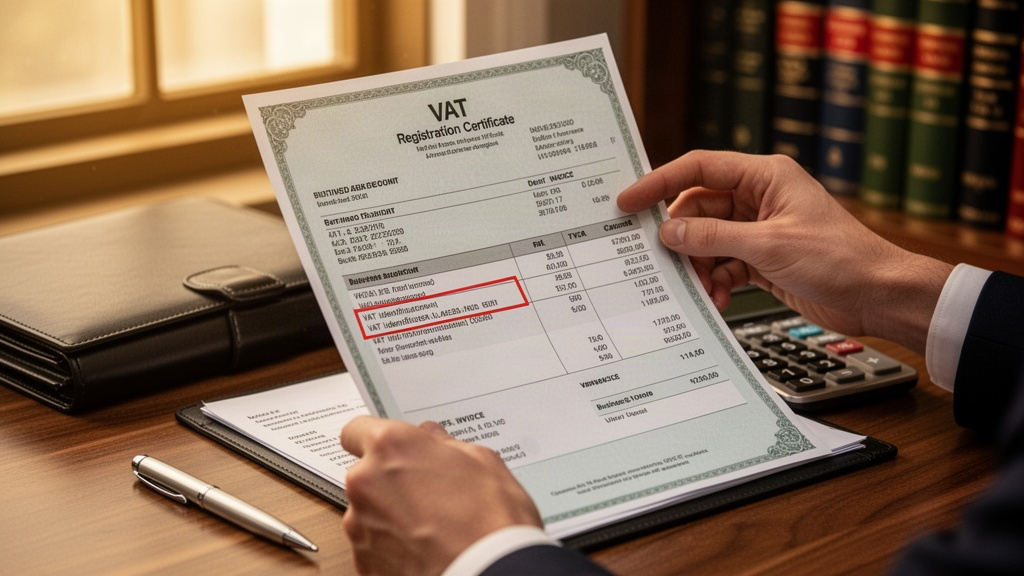
- The VAT registration certificate issued by HMRC (or the equivalent national authority), sent after successful registration
- Your online tax account — in the UK, this is the HMRC Business Tax Account accessible via GOV.UK
- Any VAT return previously submitted, where the number appears in the header
- Existing VAT invoices your business has issued, where the number is a mandatory field
- Correspondence from HMRC, including reminder letters, assessments, or compliance checks
In the UK, businesses with taxable turnover exceeding £90,000 over any rolling 12-month period are required to register for VAT — a threshold that has been in force since 1 April 2024. Below that threshold, voluntary registration is possible and sometimes financially advantageous, particularly when a business regularly reclaims input tax.
For businesses registered in EU member states, the VAT number is issued by the national tax administration of the country of establishment. Irish businesses receive a number from the Revenue Commissioners; German businesses from the Bundeszentralamt für Steuern. Each country's portal provides access to registration certificates and number lookups for registered taxpayers.
If you cannot locate your number through any of these channels, contact the relevant tax authority directly. In the UK, HMRC's VAT helpline can confirm your registration status. Do not attempt to quote an estimated or reconstructed number on any invoice or return — using an incorrect VAT number on a tax document is a legal error with potential penalties.
How to Check Whether a VAT Number Is Valid
Verifying a supplier's or customer's VAT number before completing a transaction is a standard due diligence step, particularly for B2B cross-border sales where VAT treatment depends on the buyer's registered status.
The verification tools and their limitations differ between the UK and the EU:
- For UK VAT numbers, use the official HMRC VAT number checker available on GOV.UK — it confirms whether a GB number is currently registered
- For EU VAT numbers, the VIES system (VAT Information Exchange System) operated by the European Commission allows cross-border checks across all member states
- For Irish VAT numbers, the Revenue Commissioners provide a separate verification tool on their website
- For businesses in Australia or New Zealand, the equivalent tax identifiers (ABN and NZBN respectively) are verified through their national business registers, not VIES
A positive result from VIES or the HMRC checker confirms that the number exists and is currently active in the relevant database. It does not confirm the legal identity of the counterparty, the nature of their business, or whether the specific transaction qualifies for zero-rating or reverse charge treatment. A negative result can occur because of a recent registration not yet reflected in the database, a restriction on intra-community operations, or a temporary system outage.
Since Brexit, UK VAT numbers are no longer searchable through VIES. A GB-prefixed number must be checked through HMRC's own tool. Attempting to validate a UK number via VIES will return an invalid result regardless of whether the number is genuine. This distinction catches many businesses off guard when dealing with UK suppliers after 2020.
Always retain a record of your verification checks. If a dispute arises with a tax authority over the VAT treatment of a transaction, documented evidence of the checks performed at the time of the sale strengthens your legal position considerably.
Using VAT Details Correctly on Invoices and Transactions
A VAT invoice is a legal document, not just a payment request. Under UK law (Value Added Tax Act 1994) and the EU VAT Directive, a valid VAT invoice must include specific information. Missing or incorrect fields can invalidate the document and prevent the recipient from reclaiming input VAT.
A compliant UK VAT invoice must show the supplier's VAT registration number, the invoice date, a sequential invoice number, the customer's name and address, a description of the goods or services, the net amount, the applicable VAT rate, and the VAT amount charged. If multiple rates apply to different line items, each must be shown separately.
The standard VAT rate in the UK is currently 20%, applied to most taxable goods and services. A reduced rate of 5% applies to specific categories such as domestic energy and children's car seats. A zero rate applies to items including most food, children's clothing, and books. Some supplies are exempt from VAT entirely, meaning no VAT is charged and no input tax can be reclaimed on related costs.
For cross-border B2B transactions within the EU, the reverse charge mechanism shifts VAT accounting from the supplier to the customer. The supplier issues an invoice without VAT but must include the customer's VAT number and a reference to the reverse charge. Omitting this reference or failing to quote the customer's number correctly can trigger a tax authority challenge on both sides of the transaction.
Common errors to avoid include applying the wrong rate to a supply, quoting an expired or incorrect VAT number, and failing to update invoices when a customer's VAT status changes. Accountants and solicitors advising businesses on VAT compliance consistently flag these as the most frequent causes of HMRC enquiries.
UK and EU VAT Rules: Key Differences to Watch
The UK and EU both operate VAT systems, but they diverged after Brexit and now follow separate legal frameworks. Treating them as equivalent is a practical and legal error.
In the EU, VAT is harmonised under Directive 2006/112/EC. Each member state sets its own rates within the bounds permitted by the Directive, but the underlying structure — taxable persons, taxable transactions, input tax deduction — is shared. VIES provides a single cross-border verification tool. The One Stop Shop (OSS) scheme allows businesses selling to EU consumers to register once and account for VAT across all member states through a single portal.
The UK system, governed by the Value Added Tax Act 1994 and administered by HMRC, operates independently. UK businesses selling digital services or goods to EU consumers may need to register for VAT in individual EU member states or use the EU's non-union OSS scheme. UK VAT numbers are not recognised by VIES. The UK's £90,000 registration threshold has no direct EU equivalent — thresholds vary by country.
Other English-speaking jurisdictions use different terminology and structures entirely. Australia applies a Goods and Services Tax (GST) at 10%, administered by the Australian Taxation Office. New Zealand operates its own GST at 15%. The United States has no federal VAT; sales tax is levied at the state level with significant variation. Applying UK or EU VAT logic to these markets produces incorrect results.
Any business operating across multiple jurisdictions should obtain advice from a qualified tax professional in each relevant country. The legal and administrative requirements differ enough that a single approach will not satisfy all obligations. VAT rules, thresholds, and rates change through legislation and administrative guidance — always verify current figures with the competent tax authority before filing or issuing invoices.